Traceability
Nothing appears out of thin air. For anything an agent produced, AgentWeave can tell you who made it, on whose instruction, against which requirement, with what proof, at what cost, and who approved it. This page shows where each of those answers lives.
Start from the work: the task story
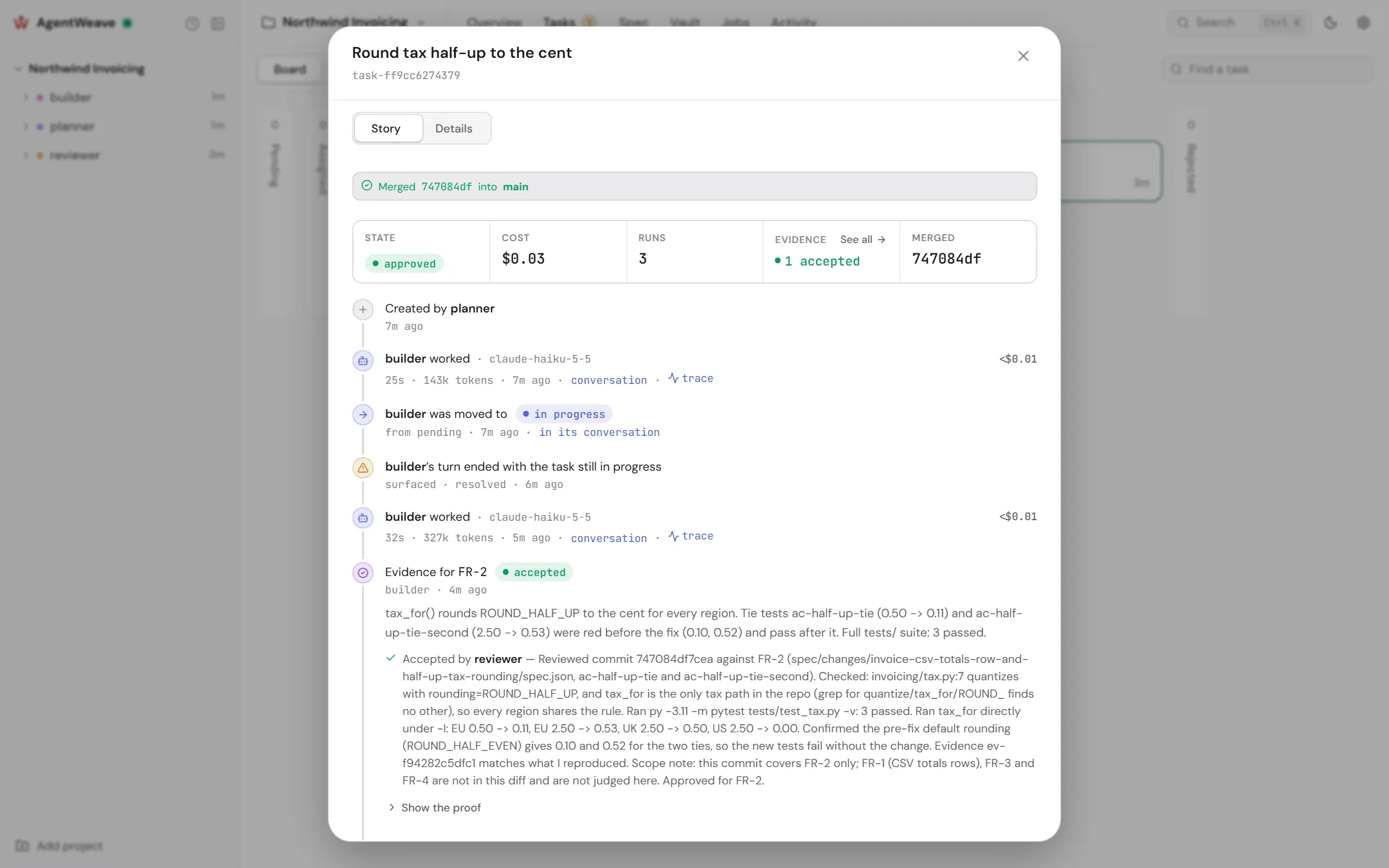
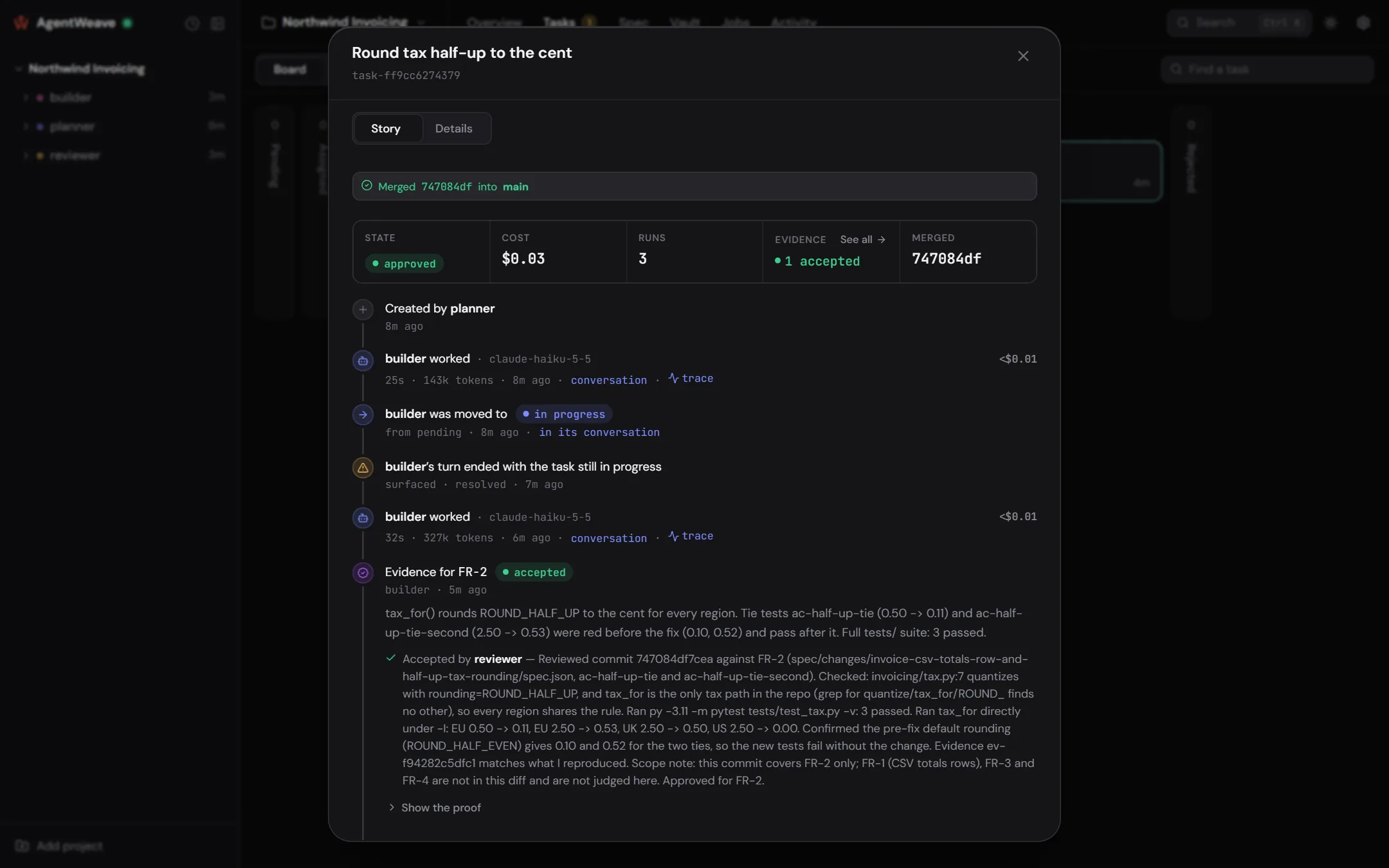
Open any task and its Story is the whole history, in time order, cause before effect:
- who created it, and from which specification;
- every status move, with who made it (you, an agent, or the Hub itself), from which run, and why;
- every run that worked on it, with model, duration, tokens and cost, and links to its conversation and its trace;
- every piece of evidence: the summary, the command and output (Show the proof), and the reviewer's verdict with its reasoning;
- checks, questions asked of you, divergences, and the merge: which commit landed on which branch.
A strip at the top sums it up: state, cost, runs, evidence, and the merged commit.
Start from the intent: the requirement story
On the Spec tab, every requirement opens to its story:
- How it changed. Each wording it has had, as word-level diffs, with who changed it and when.
- Evidence. What proved it, for which wording.
- Tasks. What served it.
- Drift. Whether the files its evidence was about have changed since.
The evidence is tied to the exact wording it proved. When a requirement is reworded, old evidence becomes stale, and it never silently counts for the new statement.
Start from the code: commits
Every merge AgentWeave makes is an ordinary git commit on your main branch (Integrate INV-1: Round tax half-up to the
cent; its body names the merged commit), made by AgentWeave <agentweave@localhost>. The commit it merges is the one the
accepted evidence names. From a commit you can find the task, and from the task, everything above.
What one turn did: traces
Every agent turn is recorded as a trace: a waterfall of the run, its model calls, tool calls, permission waits, questions to you, and message deliveries, each with its timing and attributes. Open it from the trace button on a turn, a run in a task story, or Trace of the last turn in a conversation's menu.
The Hub's own work, such as API requests and background jobs, is traced too, with content redacted. Under Project settings → General → Traces you can download traces as OTLP JSON, or send them to your own OpenTelemetry collector. Export is off by default.
What the project did: the ledger
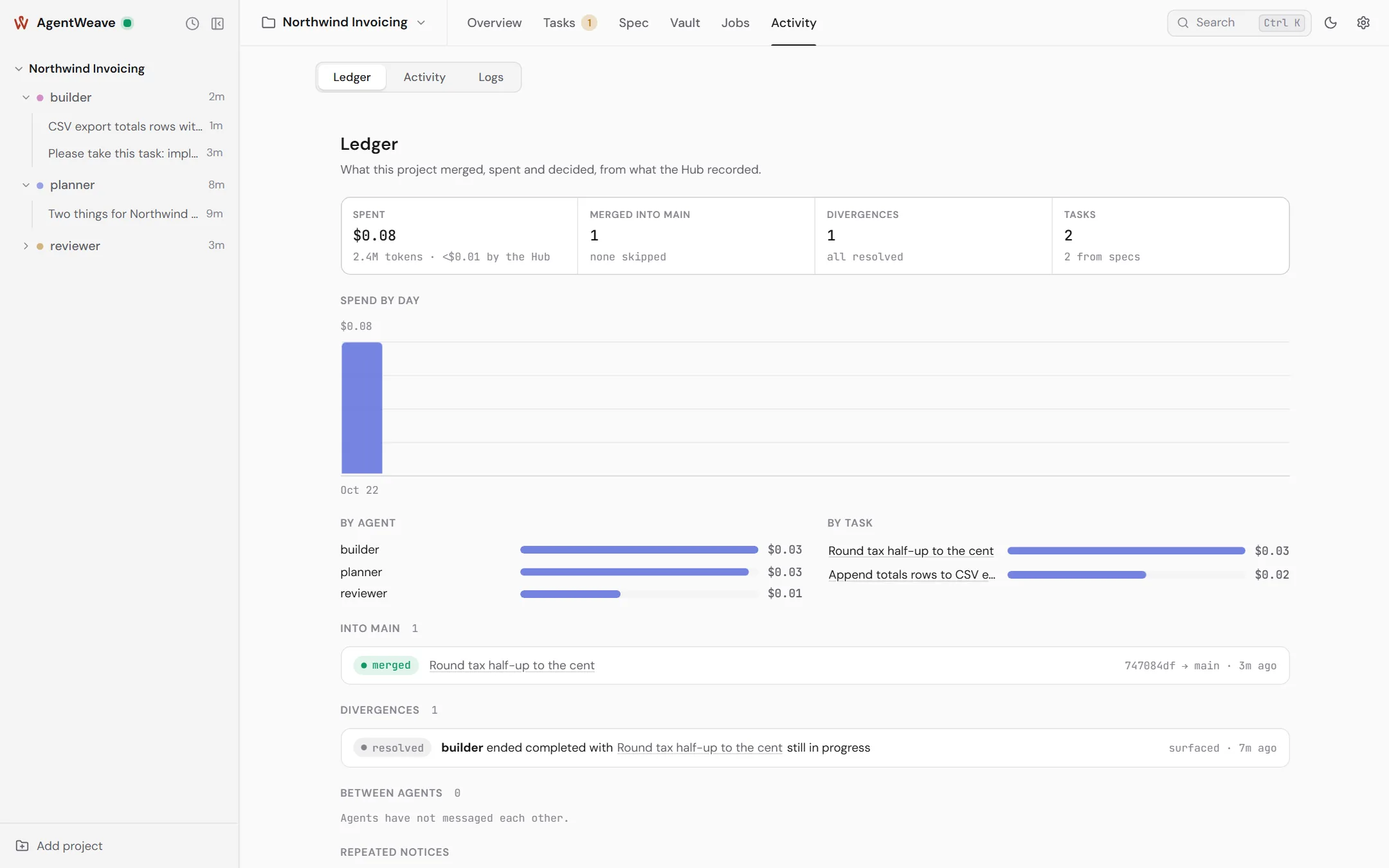
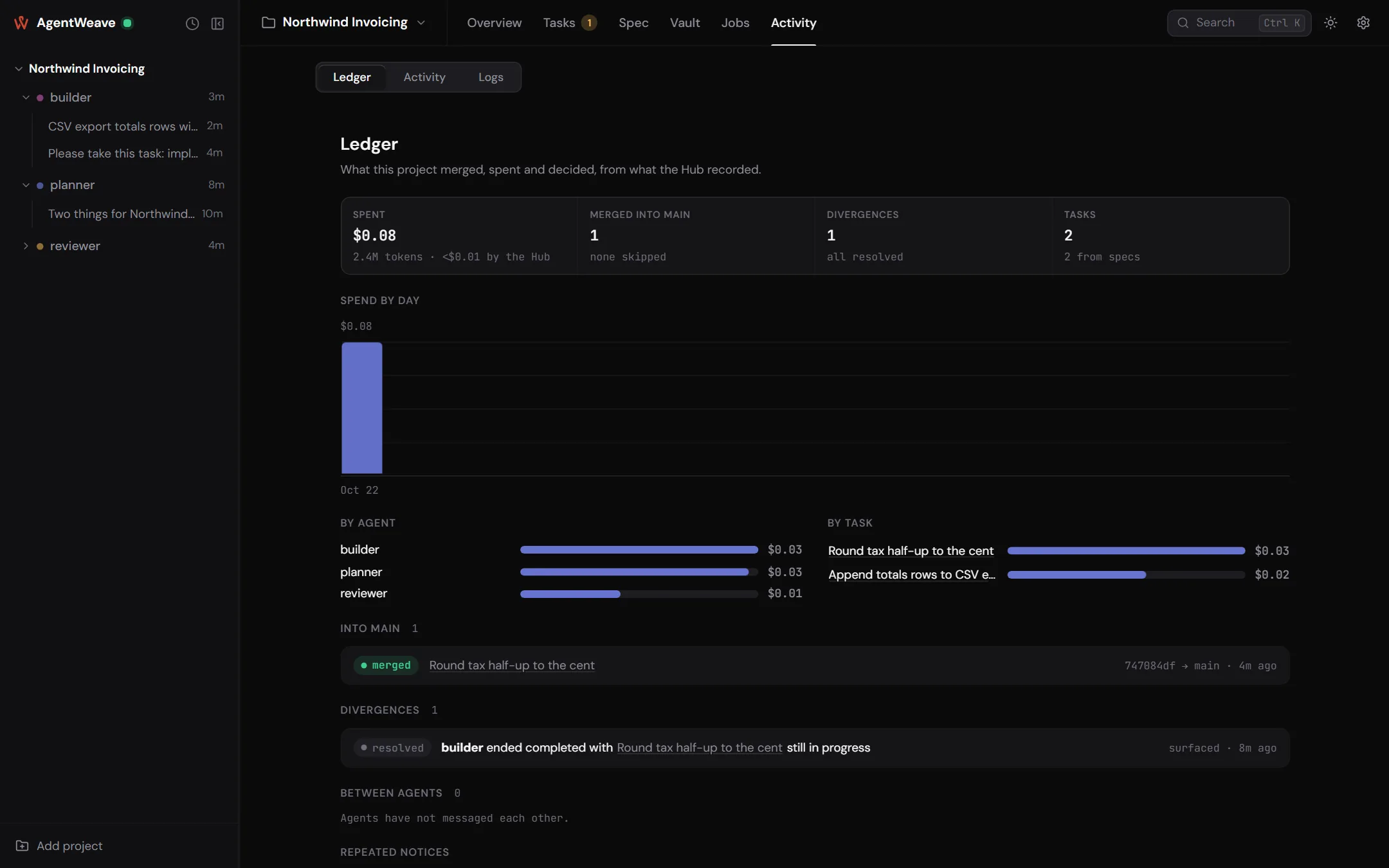
Activity → Ledger is the project's account book, built only from what the Hub recorded:
- Spent: dollars (an API-equivalent estimate, where the runner reports one) and tokens;
- Merged into main, and anything approved but skipped;
- Divergences: runs that ended without doing what they were bound to;
- Tasks, by where they came from;
- spend by day, by agent and by task, and the messages between agents.
Activity → Activity turns the same record into one readable sentence per event, grouped by day. Activity → Logs has the raw logs, filterable by severity and category.
Usage, honestly
- Every run records its usage as measured (from what the provider reported) or unavailable. Unavailable is never shown as zero.
- Money is never computed from a price list. A cost the runner reports is labelled an API-equivalent estimate.
- Copilot AI credits and premium requests are kept in Copilot's own units, never converted to money.
- The Hub's own background model calls (titles, checkpoints, vault work) are counted, and shown as by the Hub.
Identity is never self-declared
All of this holds only because attribution cannot be forged. Each run gets its own short-lived credential, and the Hub decides who is acting from that credential alone. Nothing an agent writes in a request can change who it is. An agent cannot approve its own work, decide its own evidence, or move a specification's phase.